Where the Town Pauses: Reading Dunbar Through Its Seats, Shelters and Waiting Spots
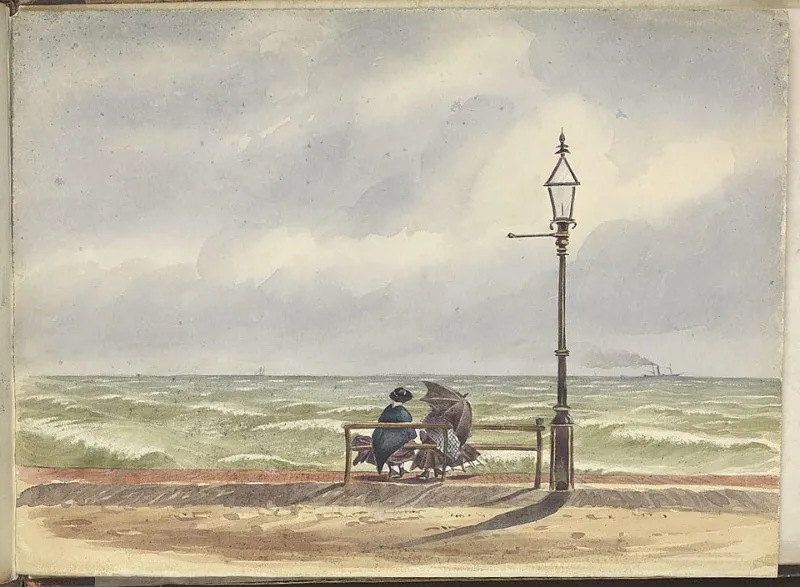
Photo: George Pechell Mends, Public domain, via Wikimedia Commons
There is a particular kind of disappointment in arriving somewhere and discovering there is nowhere to sit down. It is not dramatic. Nobody writes a letter about it. They simply shorten the outing, turn for home earlier, or decide not to come next time. Repeat that decision across a few hundred households and a town quietly narrows the range of people who use it.
Dunbar has much to recommend it in this respect, and some clear gaps. What follows is an informal walking assessment rather than a formal audit: conditions change, benches are replaced, and a route that felt comfortable in spring can feel very different after a winter of coastal weather. Readers are encouraged to test these observations themselves and to report what they find.
Why a seat counts as infrastructure
We tend to classify public seating as amenity — pleasant, optional, the sort of thing that appears in a regeneration photograph. In practice it functions more like transport. For an older resident, a person with a respiratory condition, a parent with a toddler, or anyone managing a long-term health issue, the distance between two benches is the real limit on how far they can travel on foot.
That makes seating a question of access, not taste. A town that works for everyone needs places to pause at intervals that match real bodies rather than ideal ones.
The four tests we kept applying
Walking from the railway station towards the harbour, then out to the park and the coastal paths, four questions recurred.
Shelter. A seat in full exposure to a north-easterly is unusable for half the year. Walls, hedges, glazing and tree cover all matter more than the bench itself.
Surface and approach. A level, firm surface to reach the seat, and enough space beside it for a wheelchair, a pram or a walking frame. Loose gravel, cambered paving and a single narrow gap between planters can undo an otherwise good installation.
Maintenance. Rot, splintering, missing slats, and the quieter problem of seats that exist but are permanently surrounded by litter or overgrowth. A bench nobody maintains becomes a bench nobody trusts.
Visibility and legibility. Can you see the seat before you commit to the walk towards it? Is it obvious that it is for public use, rather than the private territory of a nearby business? Is there lighting for darker afternoons?
A short walking route, and what it showed
The stretch between the station and the town centre is the first real test for visitors, and it illustrates the value of a considered waiting point: somewhere to stop with luggage, or to catch a breath on an incline, changes the experience of arriving.
The High Street performs better than many town centres of comparable size, largely because the street is broad and the frontages are varied. The weakness is consistency. Seating tends to cluster where there is space rather than where there is need, so long stretches pass without a resting place and then three appear within a few metres.
Lauderdale Park is the strongest example of seating designed as part of a place rather than added to it: paths, planting and seats are arranged so that a short circuit is possible for people who cannot manage a long one. That logic — designing for the shortest useful loop — is worth copying elsewhere.
The harbour and the castle approaches reveal the opposite problem. The setting is spectacular and the seating is sparse, exposed, and in places poorly distinguished from private ground. On a bright day this reads as character. On a wet Tuesday in February it reads as exclusion.
Winterfield Park and the edges of the John Muir Country Park raise a further point about visibility and confidence: a seat that is out of sight of other people, or poorly lit, will not be used by someone who is unsteady on their feet or anxious about being alone.
What the gaps tell us about the town
None of this is unusual, and none of it is anyone's fault in particular. Public realm furniture is often inherited, installed in batches, and funded through short-term schemes. The result is a scatter of good and bad provision that reflects budget cycles rather than residents' journeys.
What is worth saying plainly is that seating reveals priorities. A town that places benches near the services people actually use — the library, the health centre, the school gate, the supermarket entrance — is a town that has thought about the whole trip. A town that places them only where there is room has thought about the installation.
A checklist for flagging a problem spot
If you find a seat that does not work, a short, specific report is far more useful than a general complaint. Note the following:
- The exact location, ideally with a landmark or a photograph.
- What the problem is — access, shelter, damage, litter, lighting or absence.
- Who it affects: an older person, a wheelchair user, a parent, a shift worker waiting in the dark.
- Whether the issue is seasonal or year-round.
- Any nearby alternative that works, so the report can suggest a fix.
Reports of this kind can go to East Lothian Council's roads and amenity services, to the community council, or to the relevant landowner where the seat sits on private or trust ground. Where a bench is missing entirely, it is often worth raising through a community group, since small capital items are frequently funded that way.
The modest measure of a decent town
Dunbar is not short of good intentions, and the town's public spaces are, on the whole, cared for. The argument here is narrower: that we should stop treating resting places as decoration and start counting them as part of how local services are delivered. The test is simple enough. Can a person who cannot walk far still reach the places the town says are for everyone? If the answer is sometimes no, the bench is the place to start.